

A Visit to the Orunia Park in Gdańsk
The Orunia Park is one of the larger city parks in Gdańsk, located in the municipality's southern part. Less popular than the more famous Oliva Park – mostly because of its less convenient transport links with the rest of the city, I suspect – this park is simultaneously much more interesting in terms of sheer variety of views and moods it offers. The change from colorful rows of flowers in the eastern, garden-like part of the park, to dense forest cover in the western and in the southern portions of the area, allows the visitor to relax and escape the hustle and bustle of the city: at first by taking a lazy walk through the gardens, then through exploring the adjacent forests. All that can be done while accompanied by a soft sound of flowing water in the background, courtesy of the Orunia Stream, and of two large ponds present within the park.
In this article you can find a short report on my visit to Orunia Park, with a description of the location, a list of highlights worth seeing, and some general reflections.
About the Park
The Orunia Park is located in the far south of Gdańsk, near the “Gdańsk Orunia” railway station. It's old, especially for a park – according to the place's description as provided by Wikipedia, its history stretches back to the 17th century – this is actually noticeable when one visits the park since the area contains a few historical sites. The park's character – its general shape and purpose, I mean – changed a lot over the centuries: at the beginning of its history, there was a hunting lodge with a small forest attached to it – then the area around the lodge was turned into a Renaissance garden – then into a botanical garden, this happened in the 18th century – then, at last, it became a multifunctional city park.
All those historical transformations are actually visible when you're taking a walk through the park, through the sheer variety of views it offers.
In the eastern part of the park – officially, the place isn't partitioned, yet I did mentally split it into three distinct parts while being there – there's a large garden, with a small group of buildings to its south. One of the two ponds is also located in this section, the Lower Pond, as well as a small fountain and an interesting monument.
In the western part, the one slightly wilder looking, there's the larger pond – the Upper Pond (which is genuinely located physically higher than the Lower Pond; who knows why, but discovering this surprised me) – and a small amphitheatre. There's also a proper forest there, with a lot of walking paths; I didn't explore it, but it certainly does look nice.
In the southern part there's a small forest located on a few hills, with a nice large clearing in the middle of it; there are a few benches there, making it a pleasant place to relax. The single most interesting historical site – even if not, sadly, particularly impressive one in terms of looks – in the park is also located there: the centuries-old ice house.
East: The Garden
The main entrance to the park is located near the crossing of Radunia Street and Nowiny Street – the closest bus stop is “Gościnna”, from which there's a very short walk to the entrance of the Orunia Park.

After passing through the gates – well, metaphorically, physically there are no actual gates – on the left we have a small group of buildings, while on the right there's the Lower Pond (the smaller of the two ponds within the park).
Starting with the buildings: definitely the biggest, in terms of sheer physical size – though also the least interesting – historical site in the park is the manor house: a building dating back to the 19th century, built in the exact same spot in which an older house existed once, one destroyed during a skirmish in the Napoleonic Wars. The house itself isn't particularly ugly, yet it isn't exactly pretty either… and its history is a bit too short and too boring to make it interesting. Nowadays, there's a kindergarten 🇵🇱 there.
Slightly more interesting are the two other buildings, in which two different institutions happen to be located: the west building houses The Musical Scene of the Gdańsk Archipelago of Culture 🇵🇱 – what a poetic name! – while the east building is the seat of the National Center for Tatar Culture 🇵🇱 – an organization working to protect the rights of the Tatar ethnic minority in Poland.
Between the buildings and the pond there's a large open space, with a lot of paths within it, and a lot of benches; the park doesn't lack in places to sit down and relax. This is the part of the Orunia Park I call “the garden”.
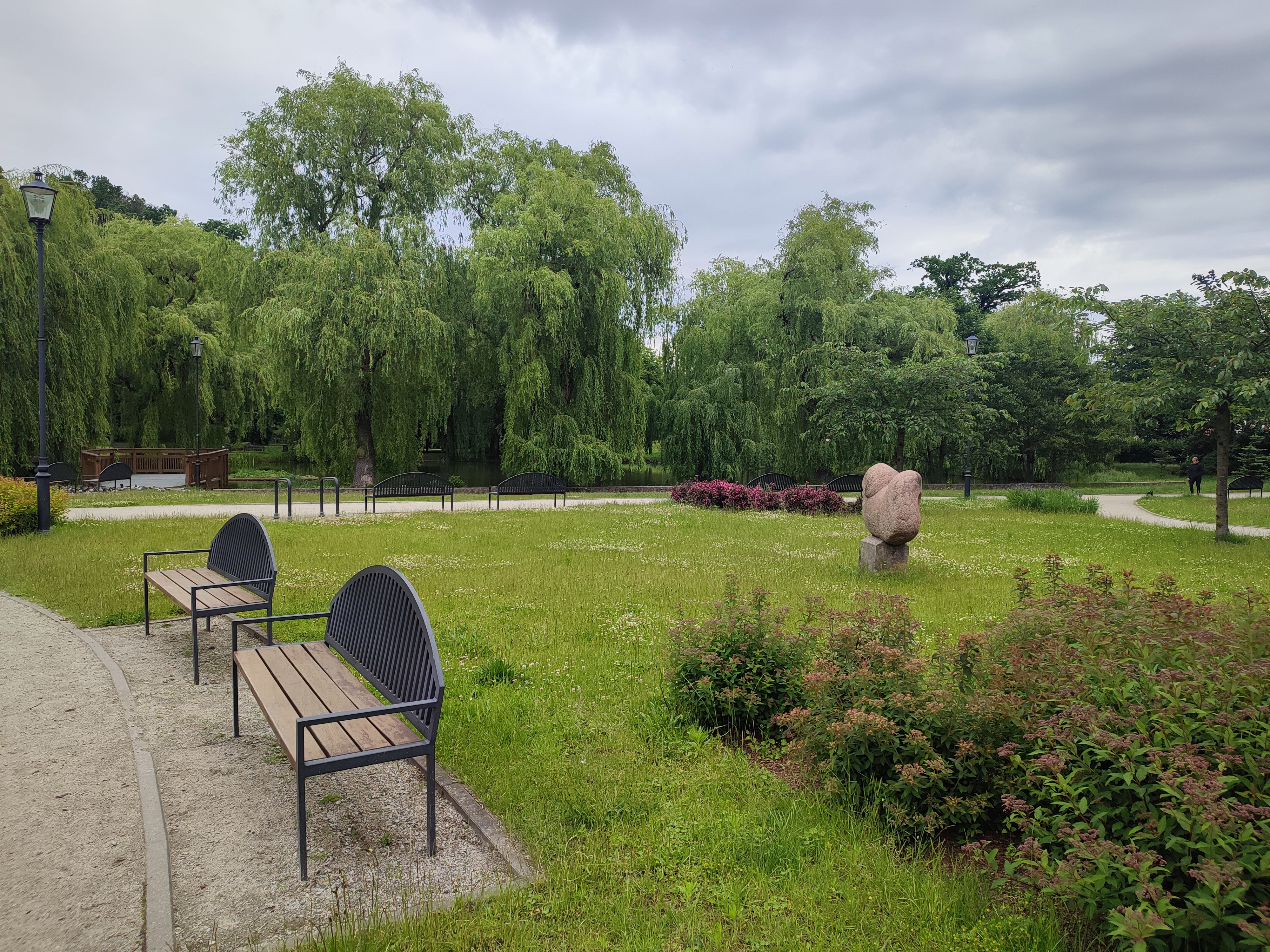
The spaces between paths are filled with flowers, very pretty and genuinely quite varied; there's also a number of sculptures there, set upon stone pedestals, which are pleasing to look at. (Though, with that said, without the help of the Gdańsk Road and Greenery Authority's website 🇵🇱, I'm quite certain that I wouldn't be able to tell that the sculptures supposed to depict a bird and a siren happen to depict a bird and a siren – they both look more like unusually shaped rocks, to be honest. The specific sculpture visible on the photo above is supposed to be a “siren”, in case anyone was curious. I haven't got the slightest whether their current look is the result of their age, or whether perhaps the sculptor, Alfons Łosowski, simply intended to give them abstract shapes like that.)
The whole garden is quite pleasing to the eye, and the sheer number of paths crossing it allows the visitor to enjoy it from every possible viewpoint. As I said before, there are a lot of benches there, placed all around, so there's no issue with finding a place to sit near your favorite spot. Together with the relatively small number of people visiting the park – and I came here in the middle of June! – it's a fantastic place to relax.
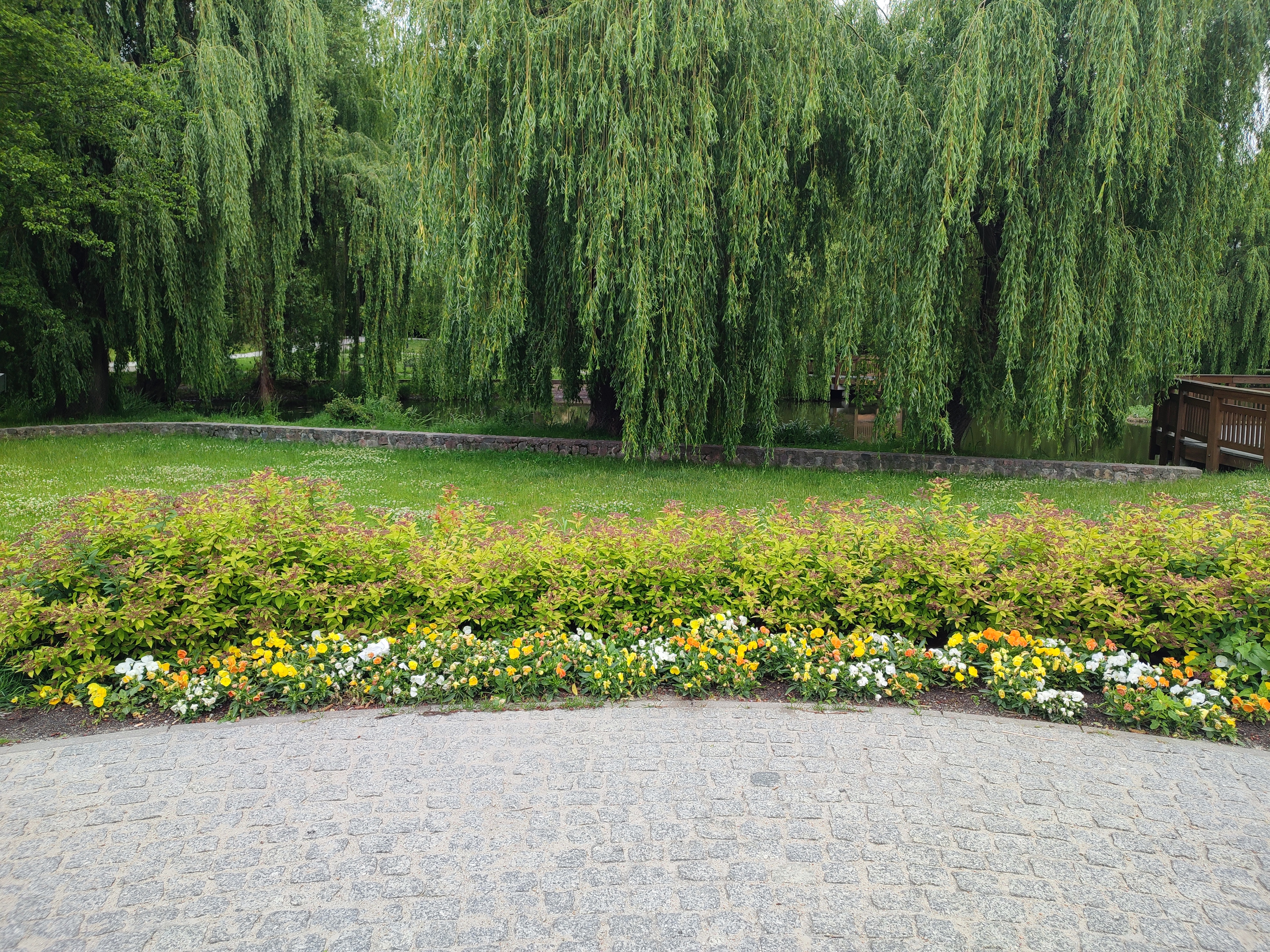
Through the park flows the Orunia Stream: a tiny creek that somehow manages to wind its way for eight kilometers before finally ending at the Radunia Canal, by the entrance of the Orunia Park – it's this stream that allows the two ponds within the park to exist.
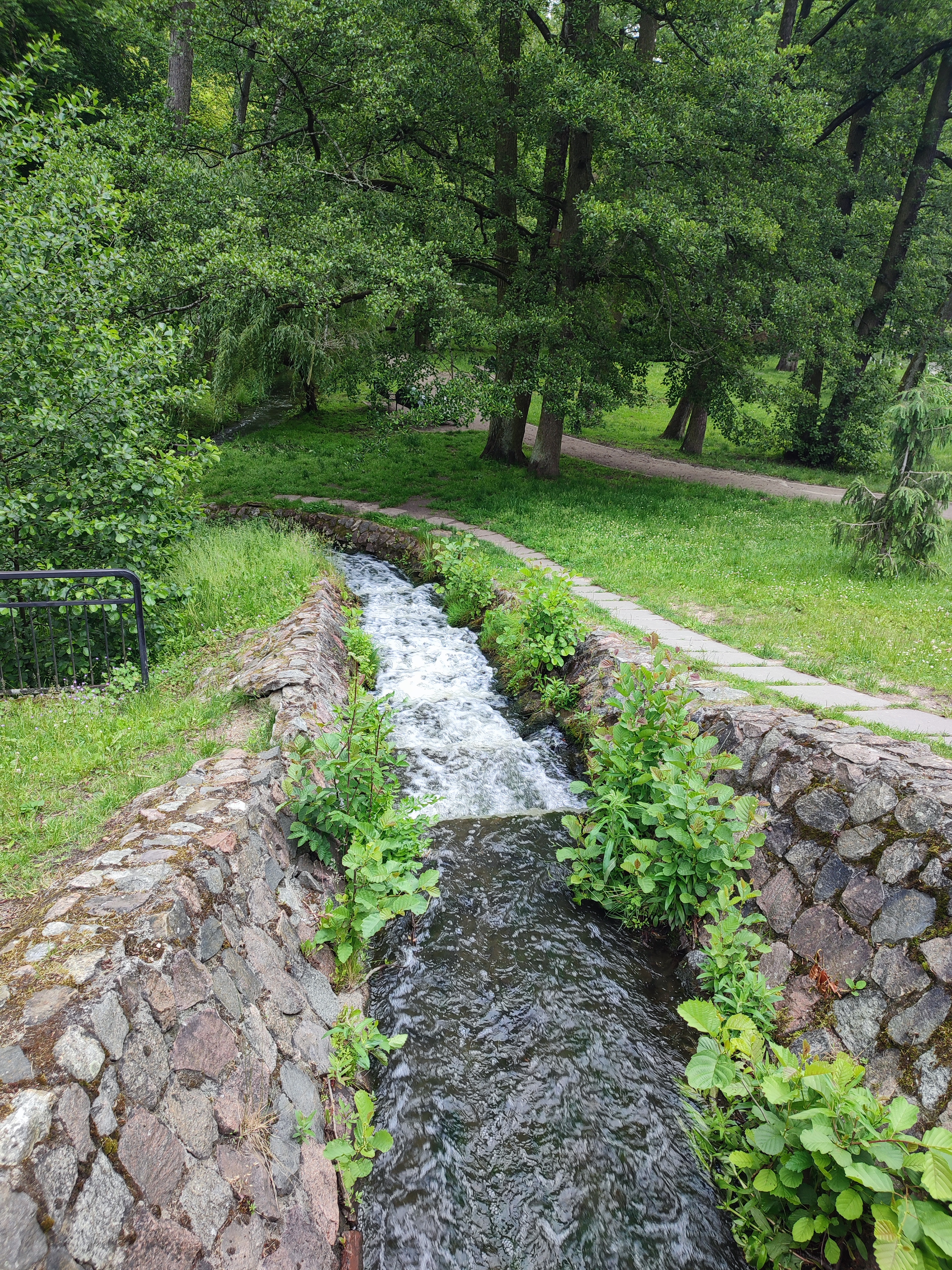
At a few different points in the Orunia Park, the Orunia Stream forms cascades… though they are tiny and, truth be told, not very spectacular.
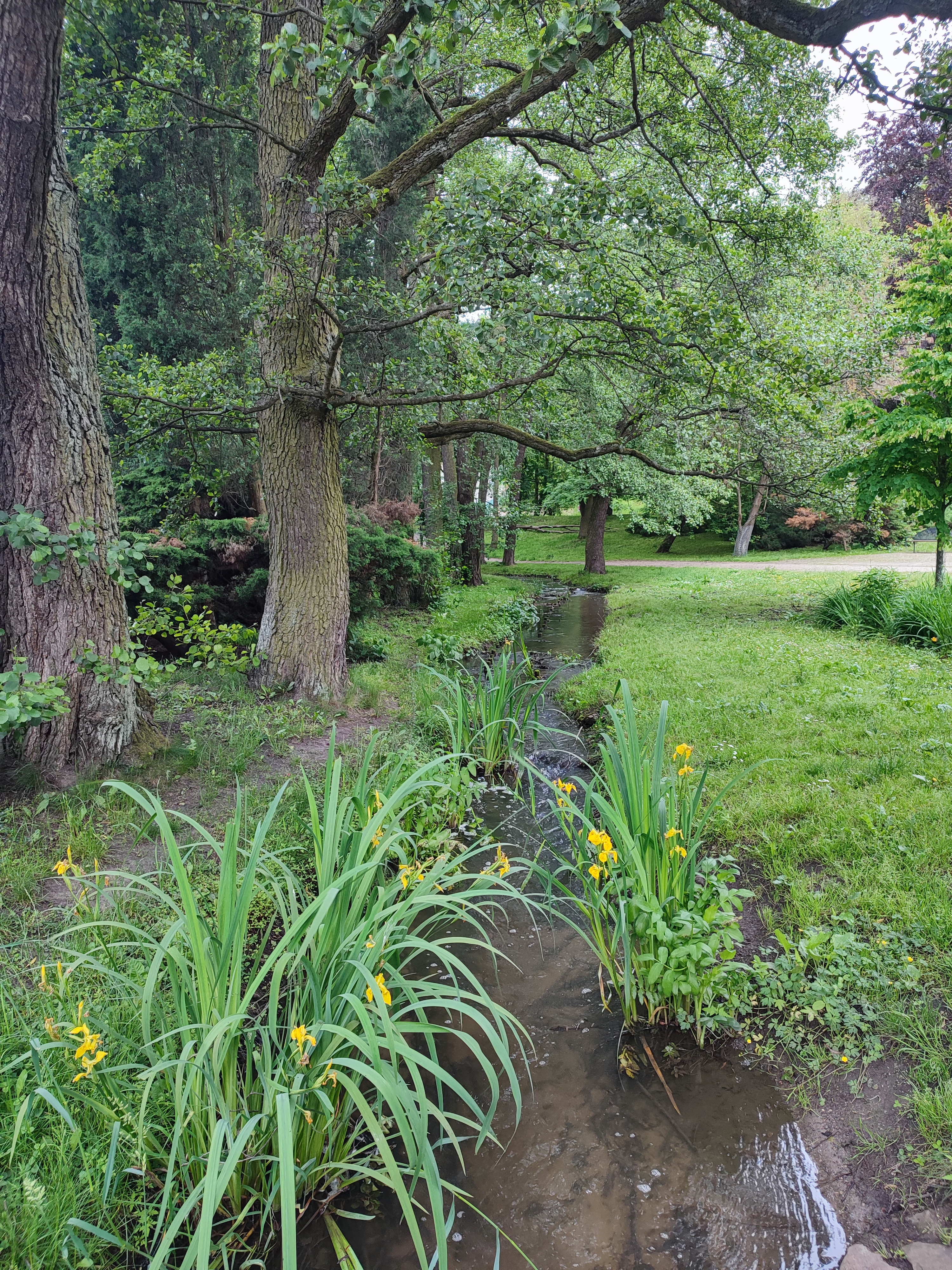
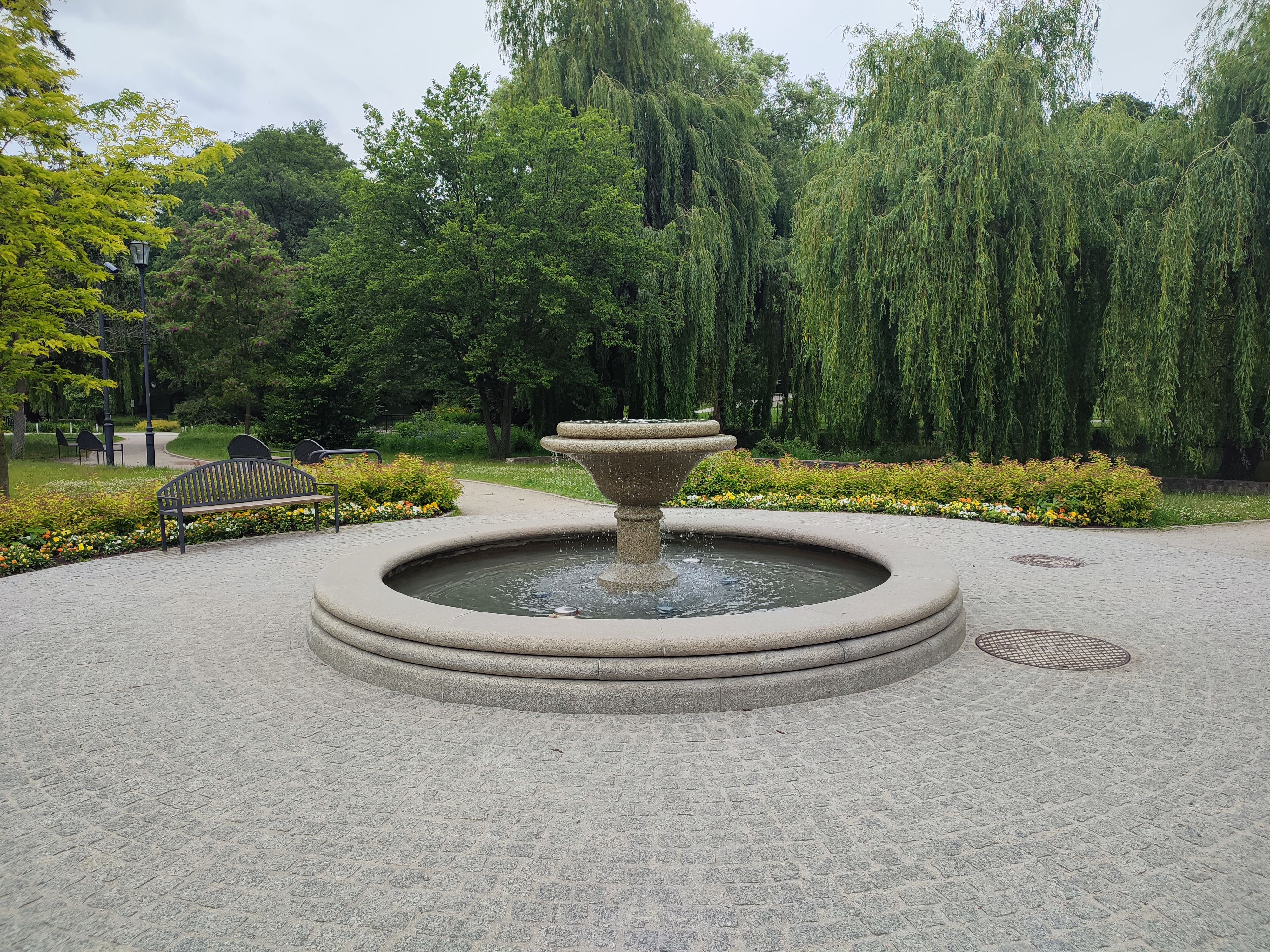
Between the buildings and the Lower Pond, in the middle of the “garden” part of the park, there's a small fountain, located in the centre of a round cobbled plaza. It's simple, as far as its design is concerned – very, ah, circular – and surrounded with a few benches.
To the north of the fountain there's finally the Lower Pond; it's equipped with two pier-like structures, serving as viewpoints.
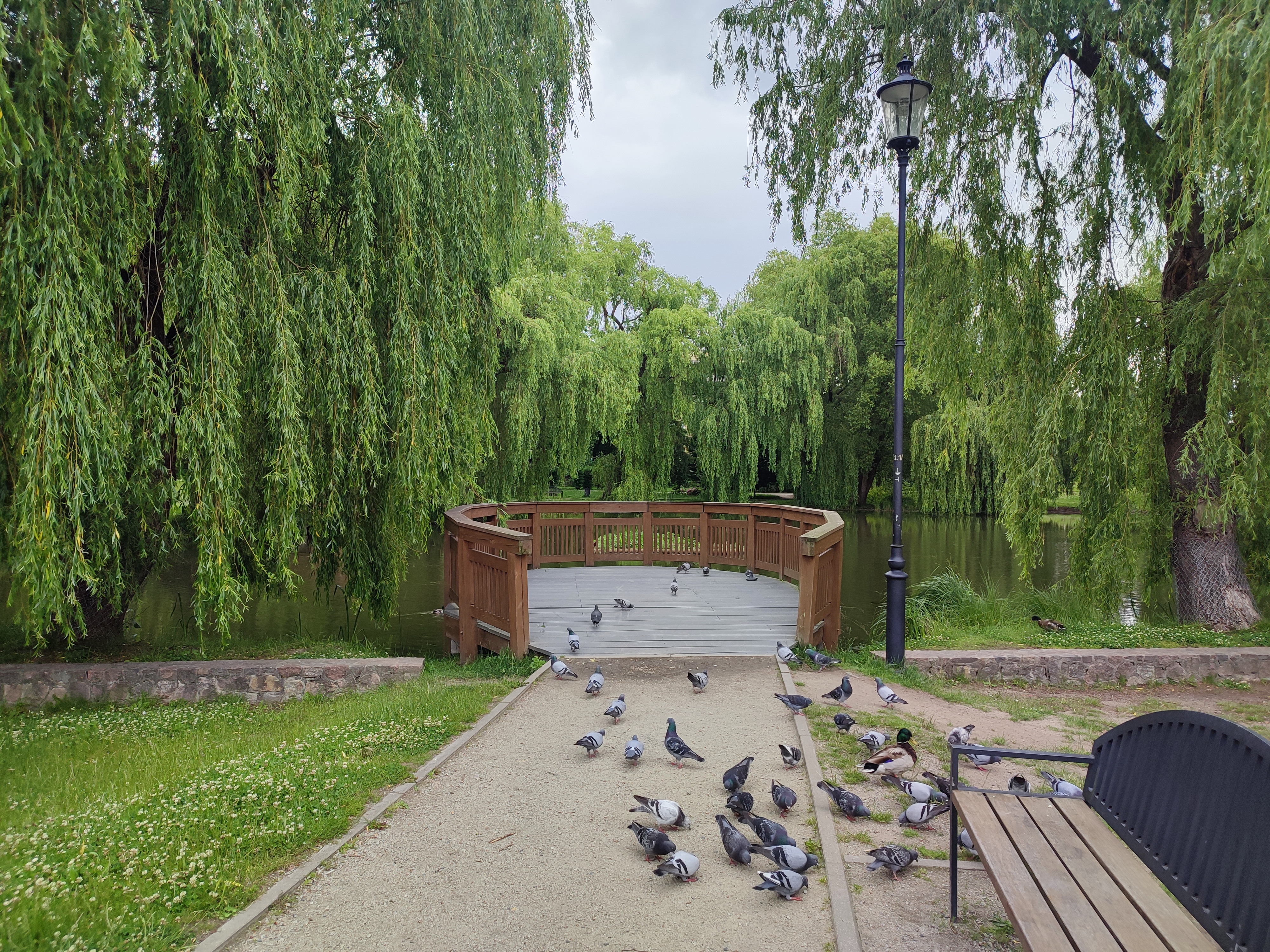
In the middle of the pond there's a tiny island, which local ducks appear to be very fond of: there was a number of them scurrying around, both in water and on the island, when I was there. They appear to be indifferent to people watching them: my presence there didn't seem to scare them away from the pier. (There's also a lot of pigeons in the Orunia Park, as you can see on the photo below… but there's a lot of pigeons in Gdańsk in general, so this is neither here nor there.)
Sadly, there's no vending machine selling bird food to be found anywhere within the park.

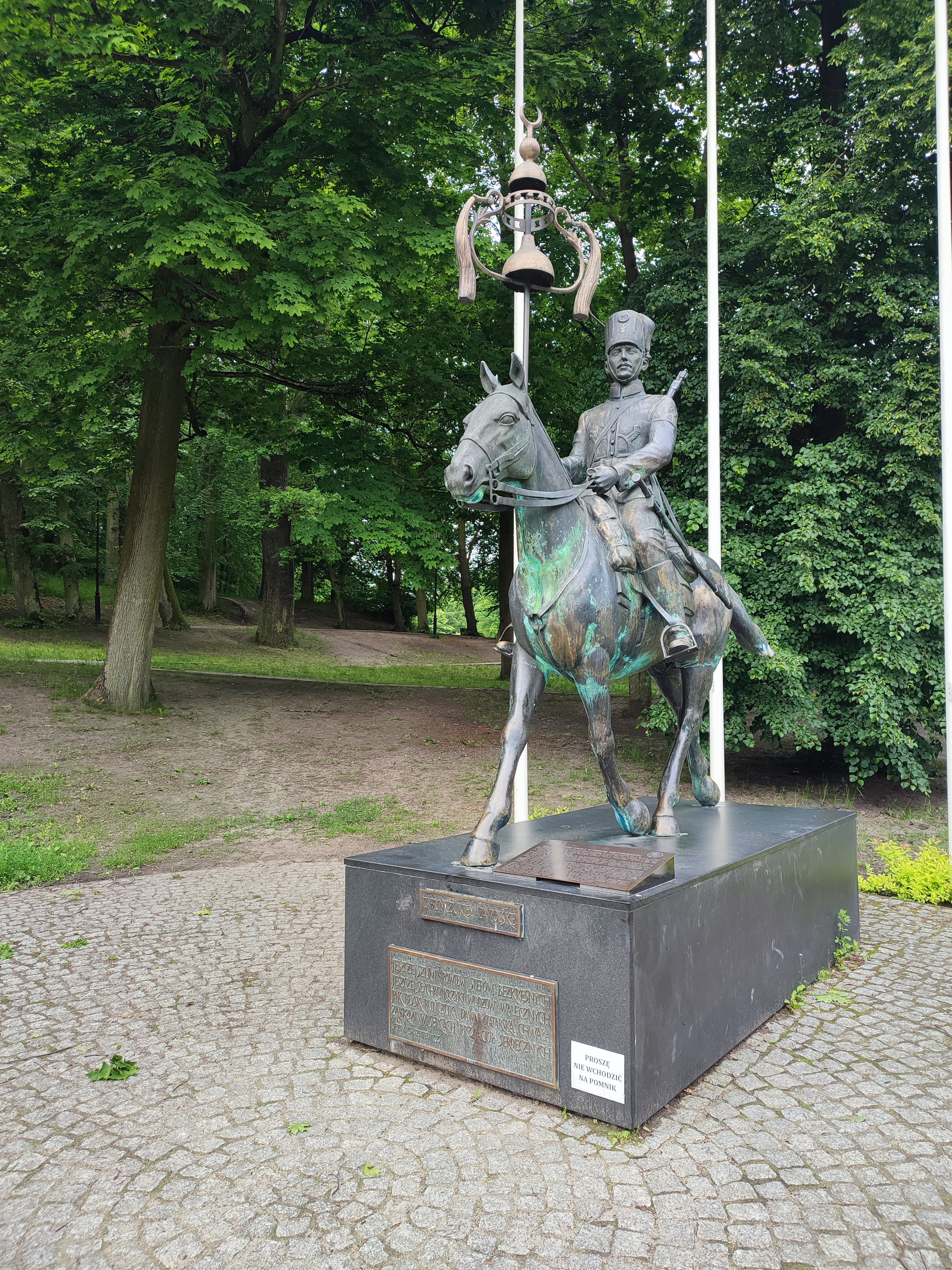
Going west, one reaches two interesting points: a large statue, bordering the southern forest and hills, and a large gazebo, located slightly to the north from the monument.
The statue is the Monument to the Polish Tatar – it's relatively new, set-up some fifteen years ago, but made out of bronze and designed in a realistic way, making it look older than it actually is. It depicts an uhlan of the 1st Tatar Squadron, a military unit of the Second Polish Republic, which was the very last unit of Tatar cavalry in the history of Polish military. The thing the uhlan's holding in his right hand is called a “buńczuk” in Polish, or a “tag” in English – it's a historical military banner used by Mongols and Tatars.
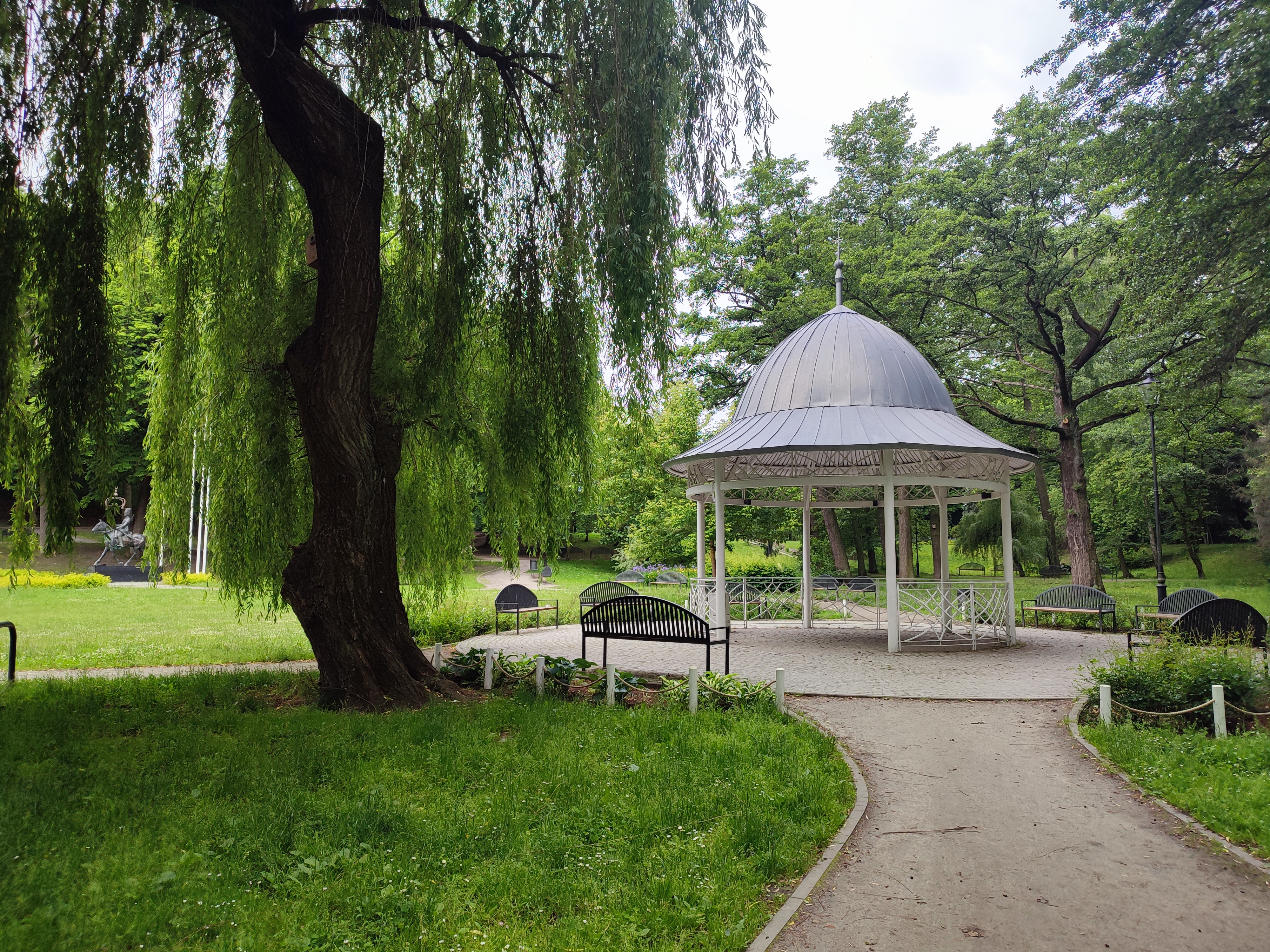
The gazebo located nearby is quite large; there's a lot of space inside, since the benches – which there's a lot of – are located around the building, but not within. Same as with the fountain mentioned before, the thing's located in the middle of a circular cobbled plaza.
Apparently, the gazebo is every now and then a location for concerts organized by the Musical Scene; that being said, they don't seem to occur frequently – more or less once a few months, according to the schedule at the Gdańsk Archipelago of Culture's website 🇵🇱.
Passing the gazebo by and making your way further west, you finally reach the wilder, western part of the park.
West: The Amphitheatre and the Forest
There are two paths one can choose to enter the western part of the Orunia Park: the northern path and the southern path. Both lead you along the coast of the Upper Pond, the larger of the two ponds, that is; in the middle of the pond there's a large fountain. The southern path begins by the Monument of the Polish Tatar, the northern path starts by the gazebo.
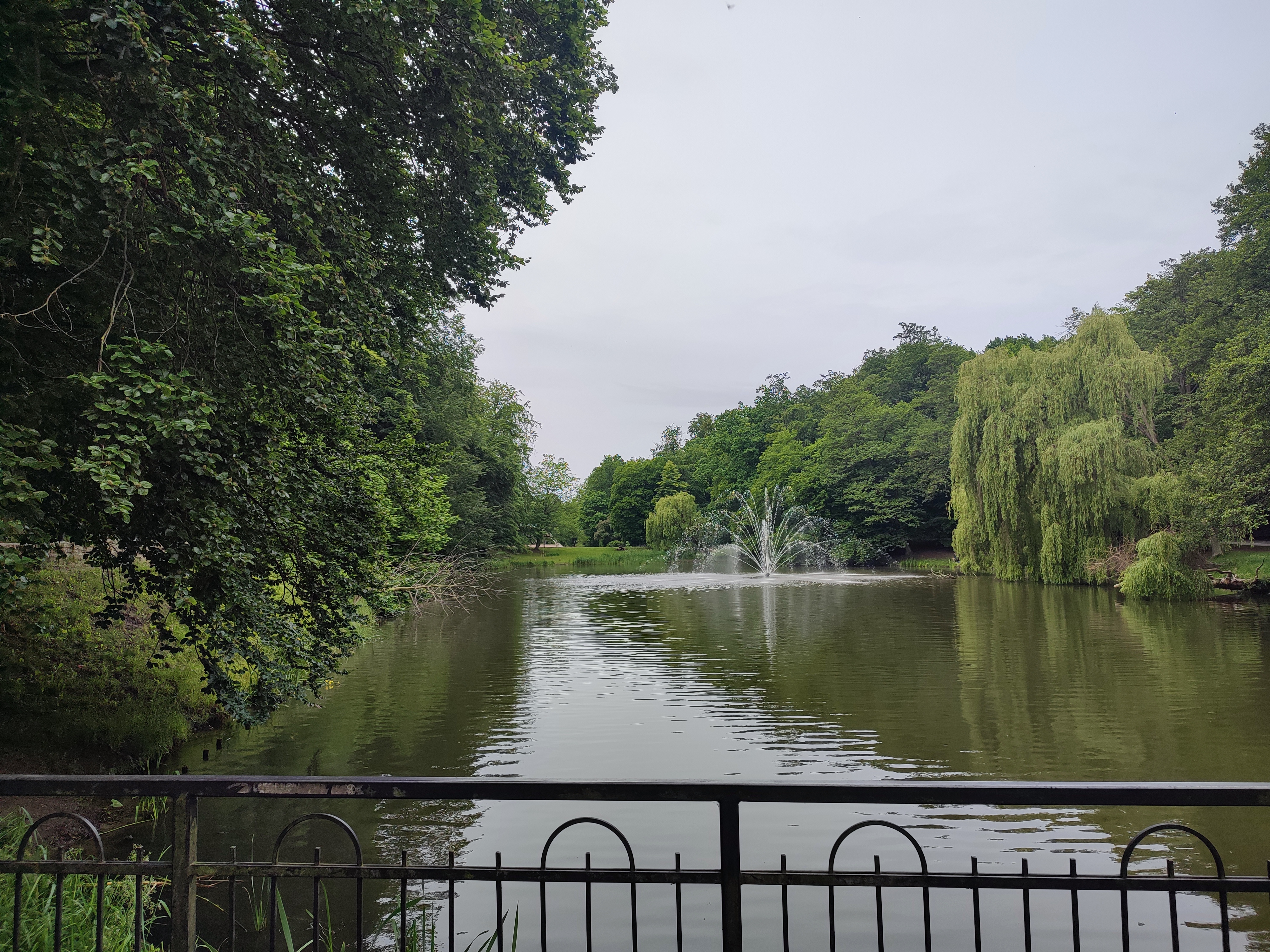
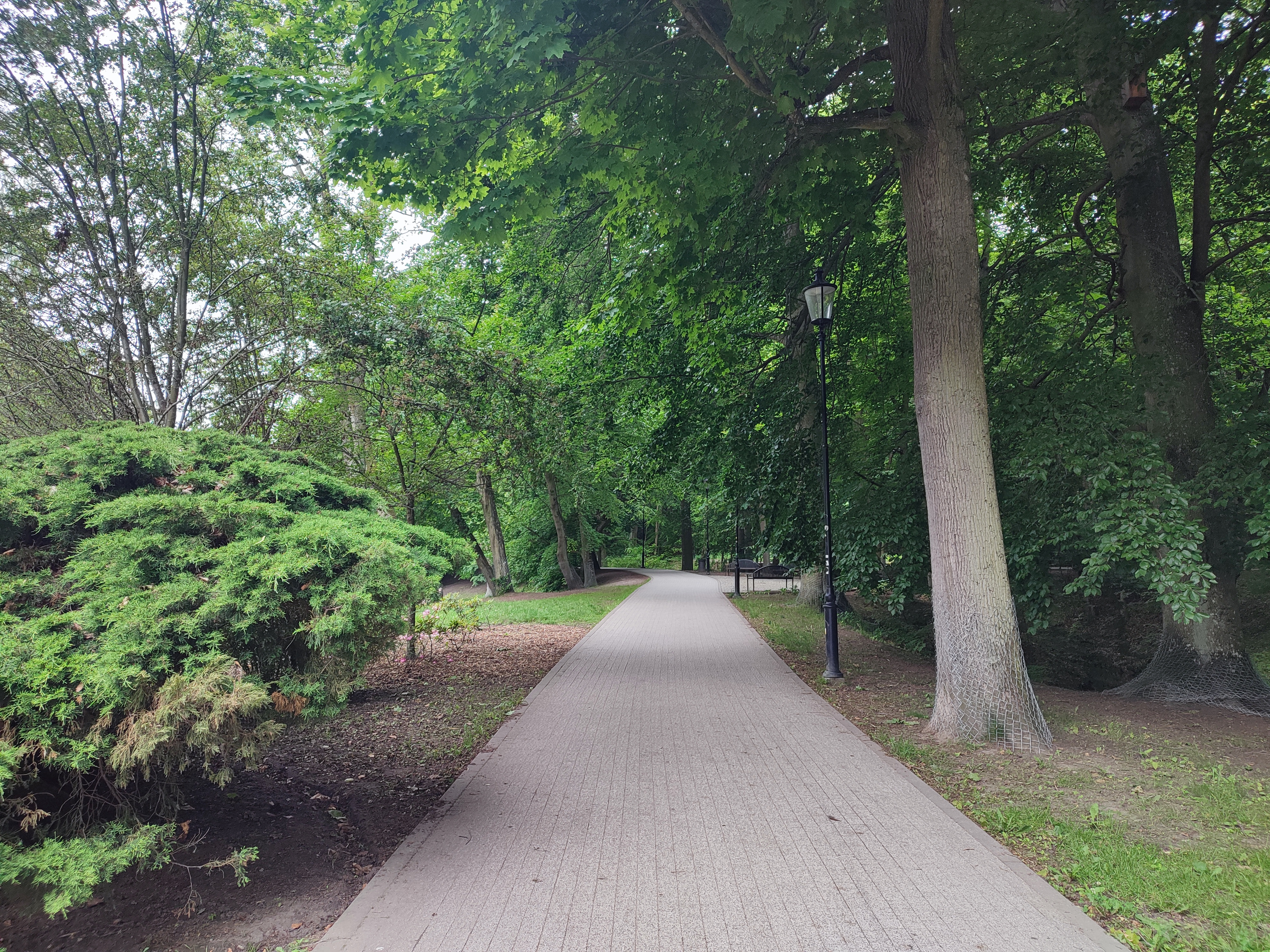
The northern path is just a few meters away from Orunia Stream, which flows along it.

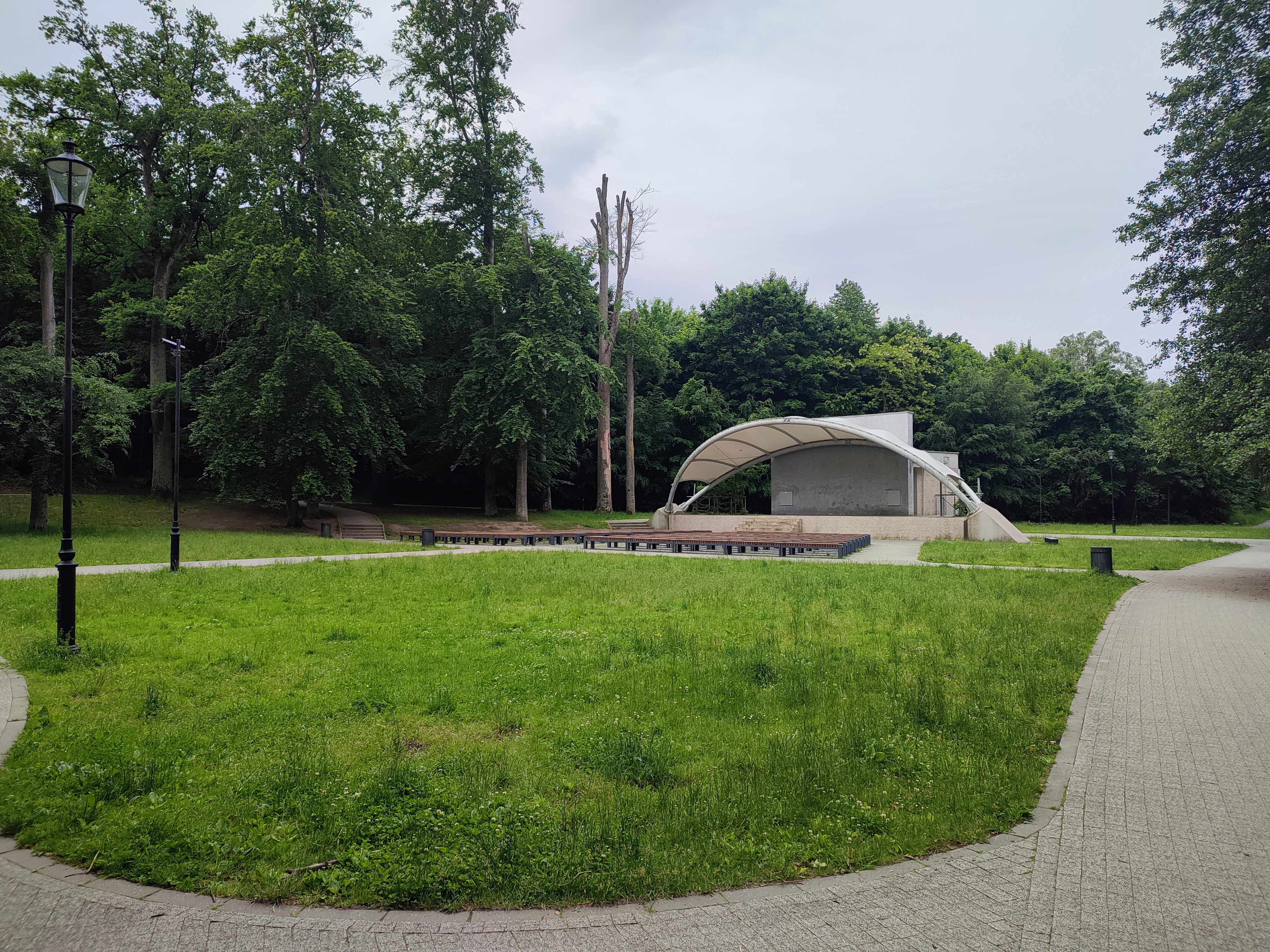
At the other side of the Upper Pond – as seen from the park's entrance – there's a small structure called “the Amphitheatre”; it's a bandshell at which every now and then concerts happen; the sheer number of benches in front of it suggests that the audience for them can sometimes be quite large.
Further west there's a large forest, which is also a part of the Orunia Park, even if it isn't obvious at first glance… or at least the map of the park published by the Gdańsk Development Office 🇵🇱 assures me that it is a part of the park. I didn't enter this forest, since I was more interested in exploring the woodland in the south, but it certainly looked nice enough from the outside.
South: A Woodland Over Some Hills
Making your way back to the entrance via the southern path, you will quickly find a smaller, well-trodden path – a very steep one – leading into the southern forest. At first, it leads into a large clearing, one equipped with eight nice benches.
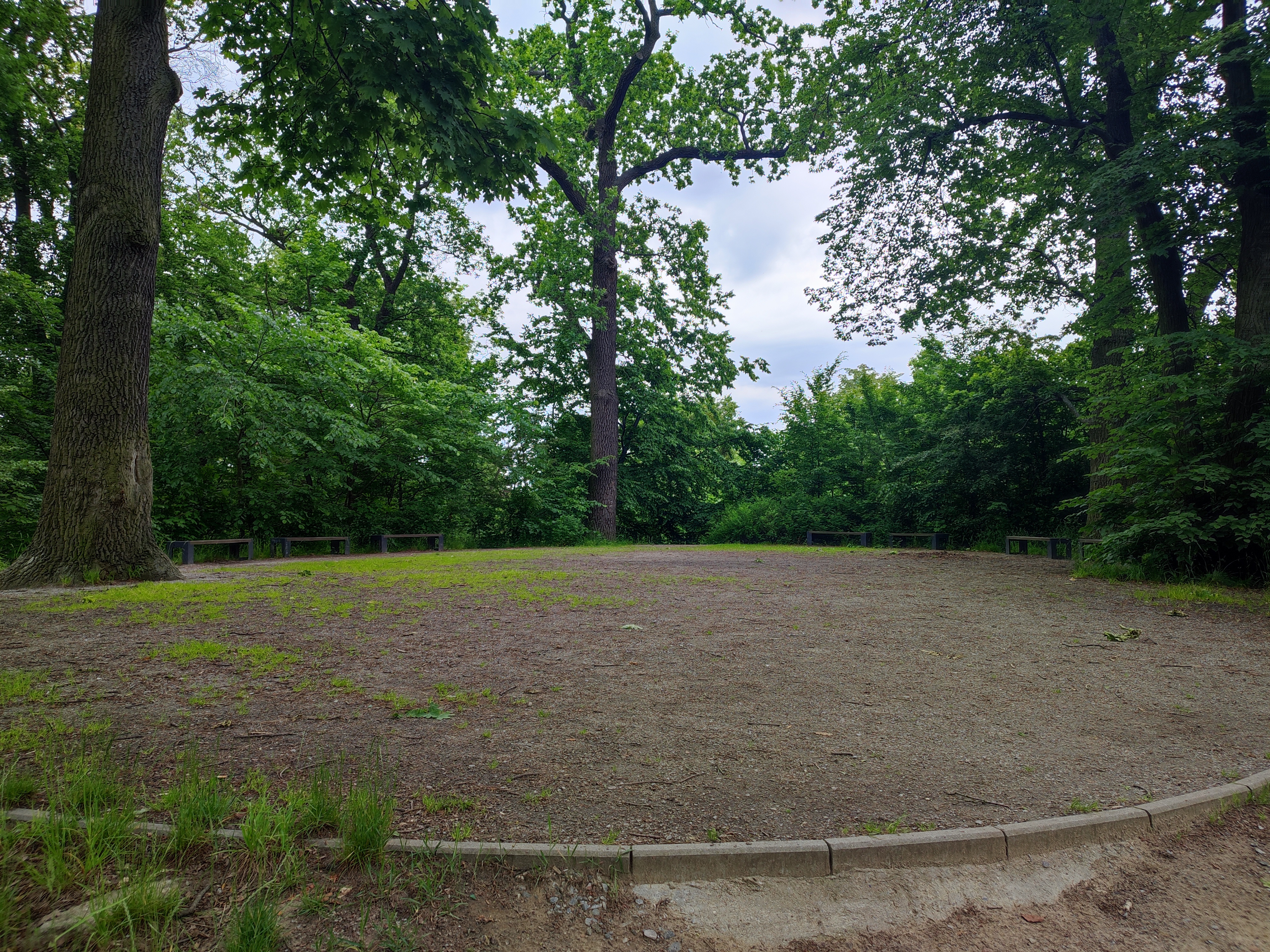
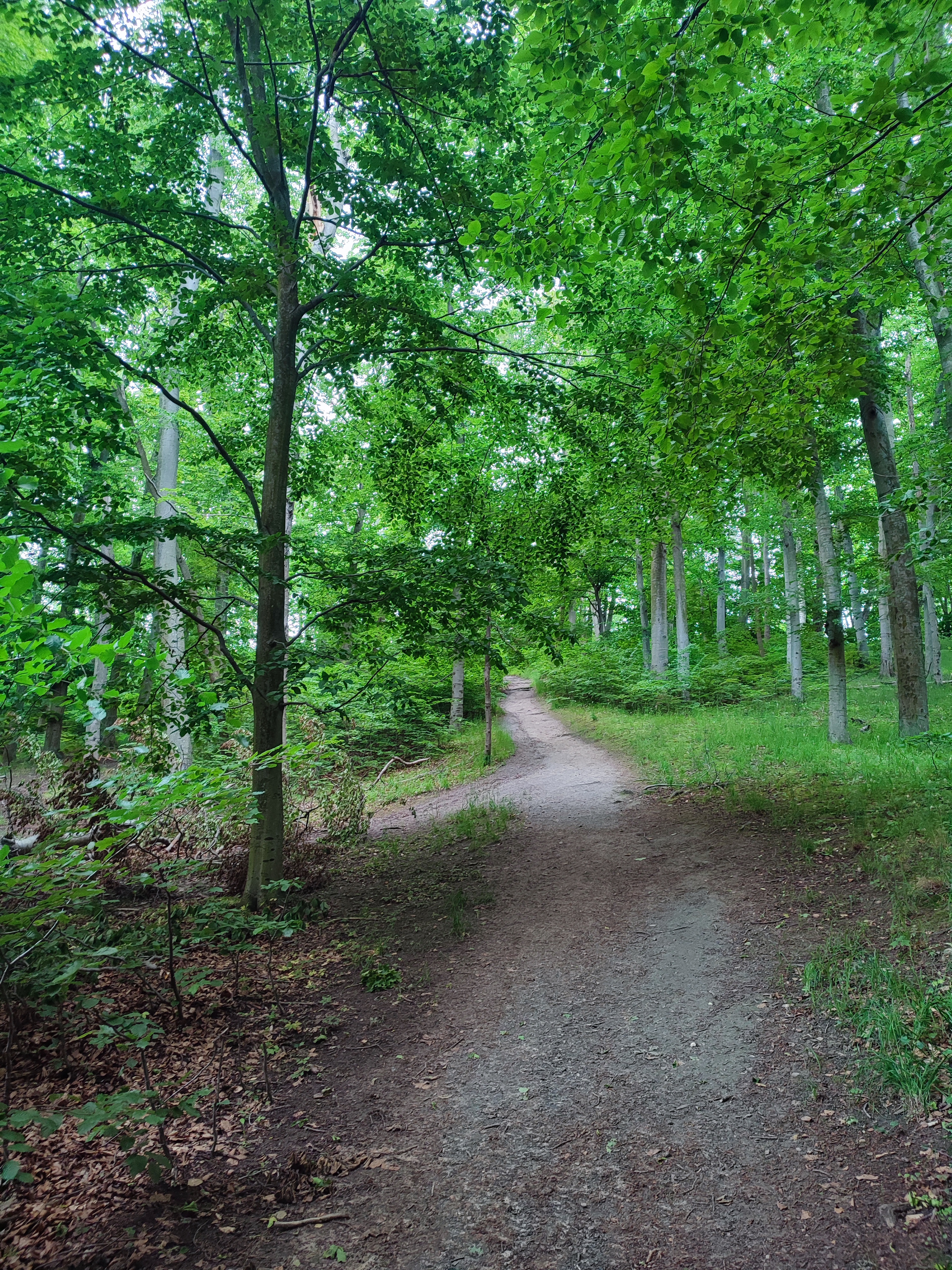
There's another path leading away from this clearing, which shortly splits into two: one path leads to the right, the other to the left.
The right path is quite steep as well (though not absurdly steep, as opposed to the one I've used to reach the clearing), and it leads back to the Amphitheatre.
The other path, the left one, allows you to go further south – this is the more interesting direction – and it quickly leaves the forest, leading into some fields. It doesn't perhaps sound all that exciting, but the mood of the place is very enjoyable: the landscape is very pleasing to the eye… and there's also a wooden block set beside the path, to serve as a place to sit down and rest for a moment.
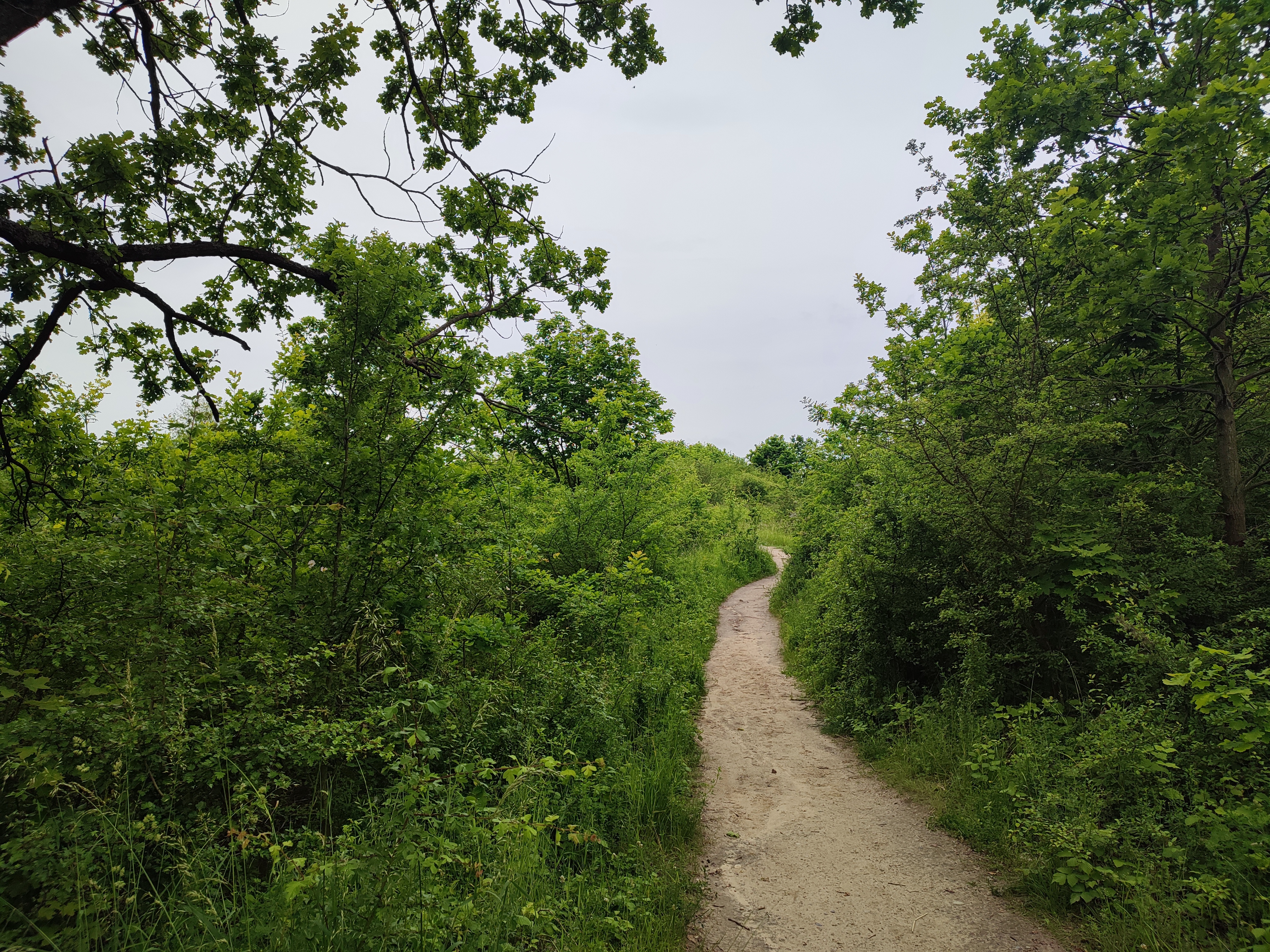
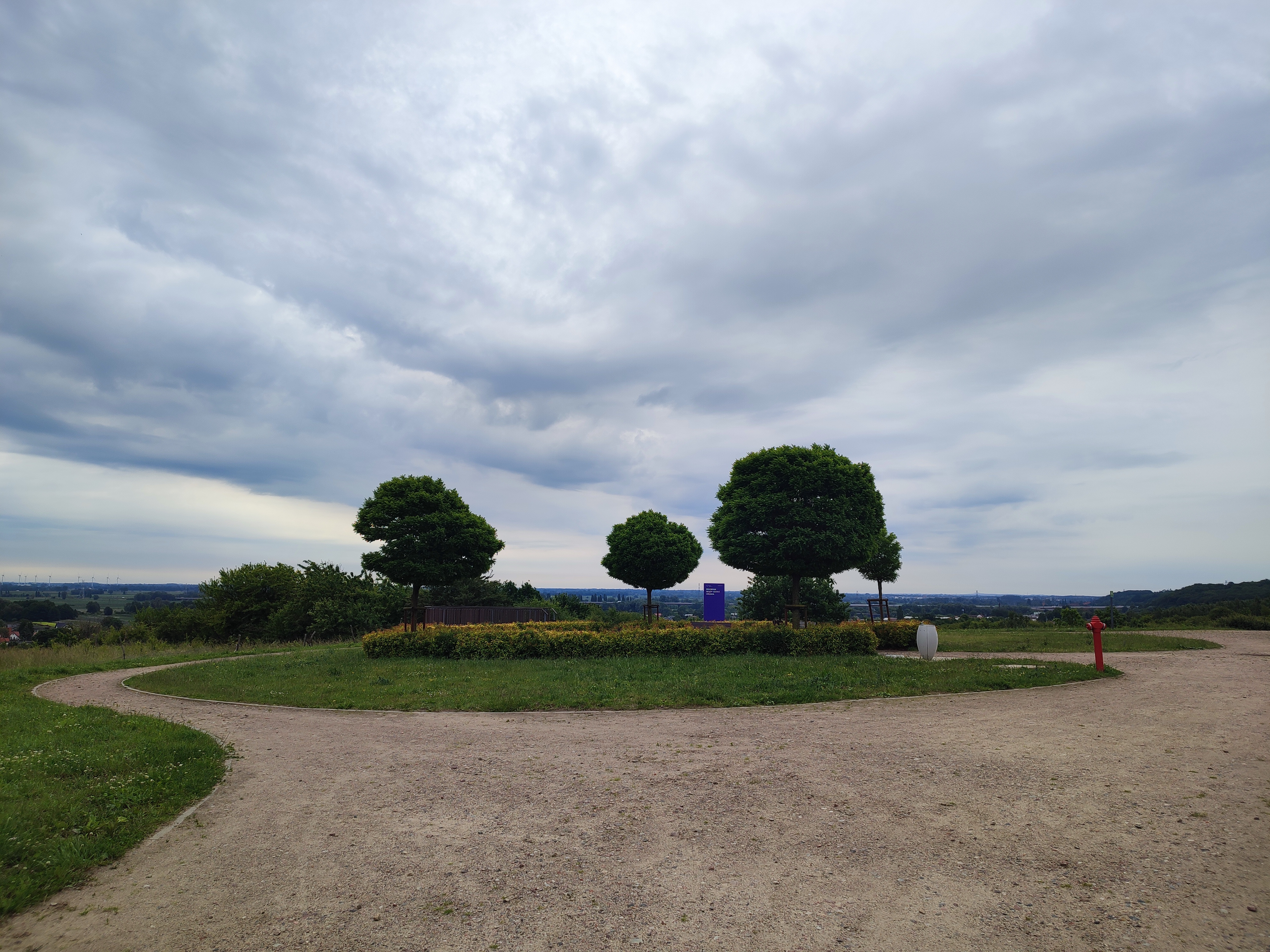
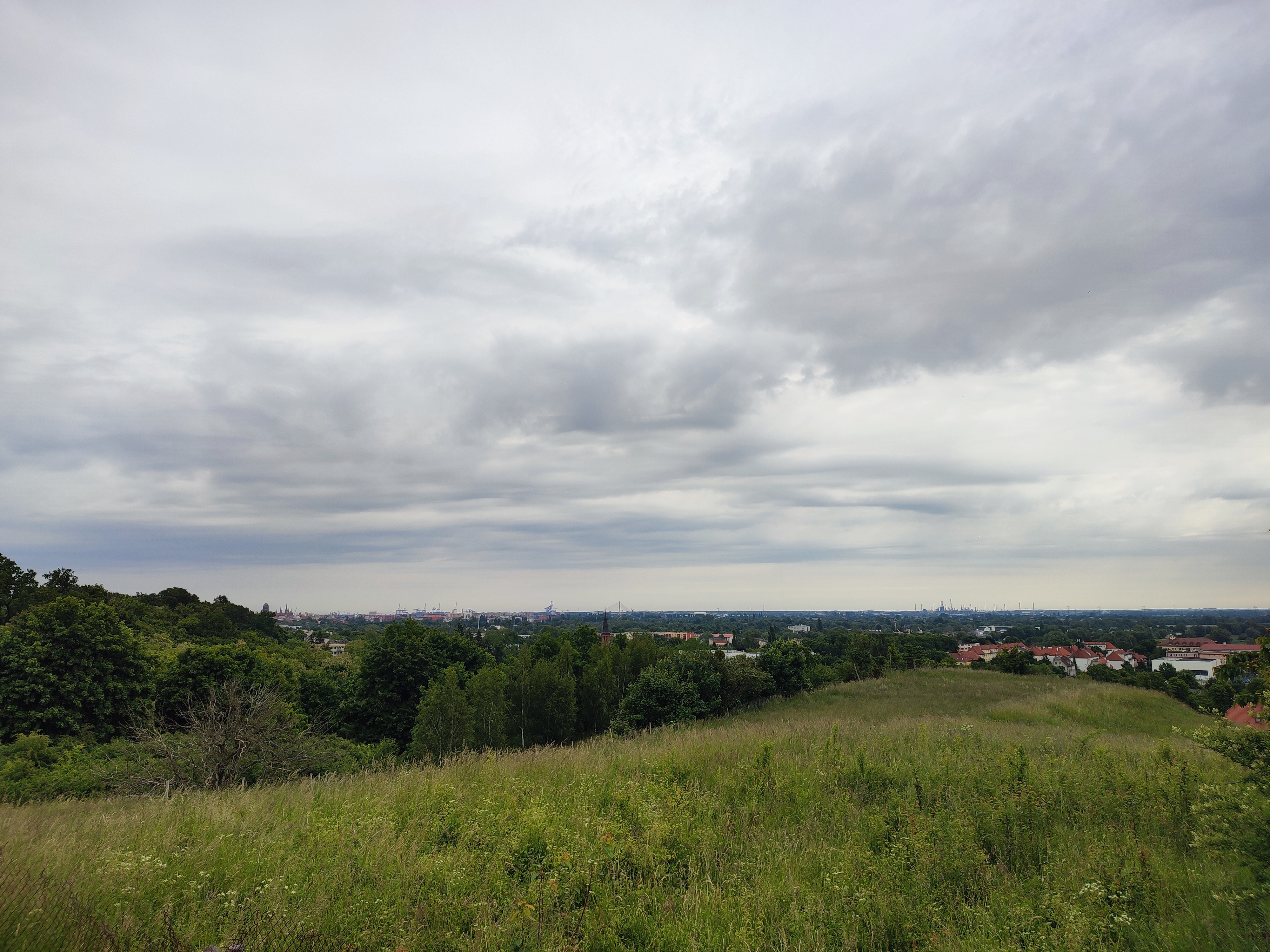
Walking down this path – or, well, walking up this path, looking at it from a strictly physical perspective – one finally reaches the Old Orunia Water Reservoir 🇵🇱, dating back to the 19th century… and still in use. Beside it, or – to be more precise – directly in front of it, there's a small recreational area, with flowers in the middle of it and with some benches, as well as high-placed viewpoint allowing one to gaze at the city below.
Retracing your steps through the forest, you can once again get to the cobbled southern path by the Upper Pond, leading back to the “garden” part of the park.

A few steps into the forest from this path, and you will find this interesting object:

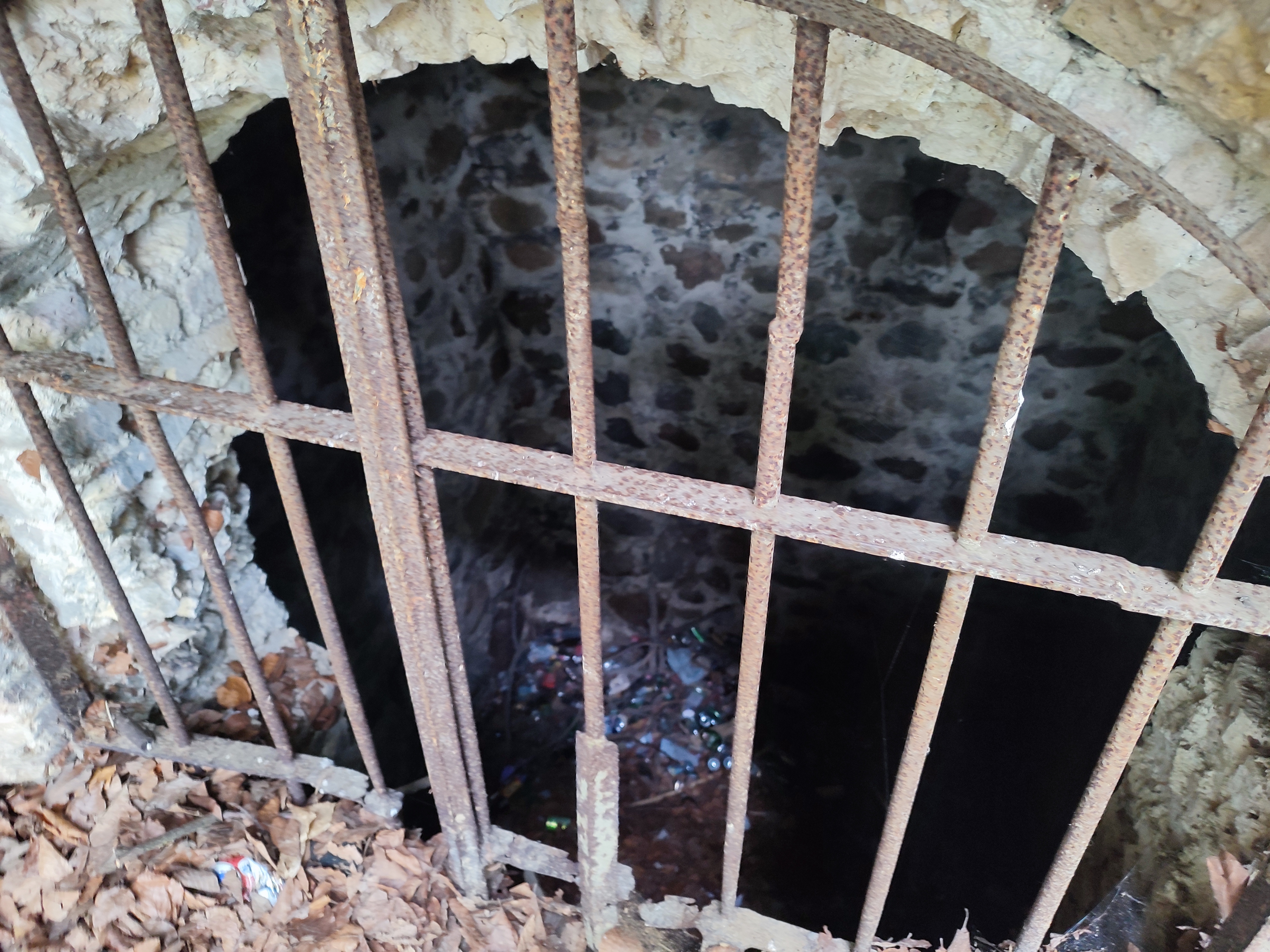
This is the ice house I mentioned at the beginning of the article.
It's the single oldest thing within the park: it dates back to the 17th century… and doesn't seem to have changed all that much over the ages, if at all. An “ice house” was, in the times of old, a place used to store ice – for that purpose it had to be very well isolated from its surroundings, for example by being underground. This particular ice house is very deep, and the opening is behind a grate.
The inside is – sadly! – full of trash.
The last segment of the path leading back to the “garden” section of the Orunia Park is a small alley, surrounded by a line of trees on each side.

Walking down this path, you will finally once again reach the Monument to the Polish Tatar.
General Impression
Personally, I prefer the Orunia Park over the Oliva Park. It's just slightly bigger – thirteen hectares, compared to eleven hectares in case of the Oliva Park – but the place is just so much more diverse in terms of moods and views!
The Oliva Park is, at its heart, a large garden, even if some parts of it can look like a woodland – the Orunia Park, on the other hand, is composed both of a proper garden and of a proper forest, which makes it so much nicer. If we count the Old Orunia Water Reservoir and the surrounding areas as a part of the park – which it isn't, technically, but it's certainly adjacent and easily accessible from the park – then it also has a section of fieldlands, offering a nice view of Gdańsk, which makes it even more interesting.
The clearing in the southern forest seems to make for a very nice place to spend some time with friends… even though it sadly lacks a fire pit or something similar. It's understandable, of course – allowing people to start a fire in a place that is, after all, slightly difficult to access, would be quite dangerous – but, regardless, it's somewhat disappointing.
As far as historical sites in the park are concerned, the manor house isn't very impressive, but – in contrast to it – the ice house is fascinating; it's a curious feeling, to see a structure like that, unchanged from the time it was constructed, probably used for centuries. The amount of trash inside is somewhat disturbing – but then it's difficult to blame the city government for this; without making the place utterly inaccessible to visitors, I don't see how they could easily protect it from idiots too lazy to look for the nearest garbage bin. (Though, truth be told, the number of trash cans in the park is a bit low – a stark contrast to the number of benches.)
The woodland and the fieldland in the southern part of the Orunia Park are both very pretty: they're beautiful in the summer, and I feel that they look even nicer in spring, especially the fields.
To sum everything up: I really loved visiting the whole place. Getting there from Wrzeszcz district is, sadly, a tiresome affair – you have to transfer from a tram to a bus, one that was overcrowded both to and fro when I rode it – and takes me almost forty minutes, yet I certainly plan on visiting Orunia Park every now and then regardless.